
2019年6月英语四级真题及答案电子版三套免费版pdf+word附听力
时间:2026-07-22 20:10
大小:78.7M
系统:WinAll
语言:中文
时间:2026-07-22 20:10
大小:78.7M
系统:WinAll
语言:中文
很多在2019年6月考过英语四级的朋友都说那次的四级写作对于考生的考查确实是刷出了新高度。虽然给出了三个选择,但都要求用新闻报道的问题进行写作,有没有那么多话写尚未可知,能不能符合格式都够人忖度良久,可谓是让人“欲哭无泪”。这里附上同期的真题三套和答案及听力,需要的自取。
本次更新重点优化了三套真题资料的排版与功能体验。PDF版本全面升级为高清扫描版,文字清晰度提升30%,打印无毛边;Word文档支持直接编辑,方便考生标注重点和错题整理。听力部分新增独立MP3文件,并内置二维码扫码即听,无需跳转第三方平台。用户反馈显示,解析部分新增了逐题考点分析和易错点提示,尤其阅读理解和翻译的详细拆解获得了广泛好评。同时,针对部分用户提出的“目录跳转不便”问题,新版增加了超链接书签,点击即可直达对应题目。资料包保持完全免费,无需注册即可下载,助力考生高效备考。

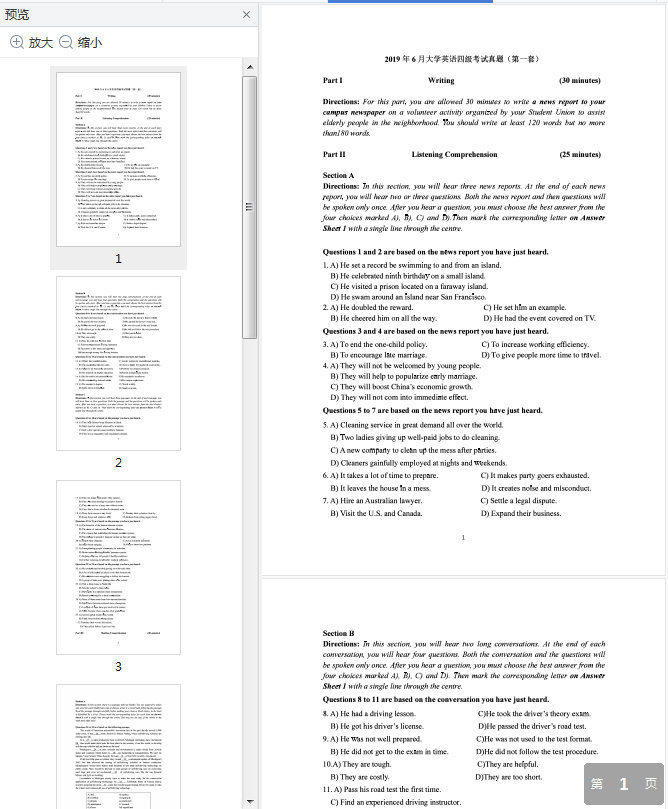
2019年6月四级真题第一套.docx
2019年6月四级真题第二套.docx
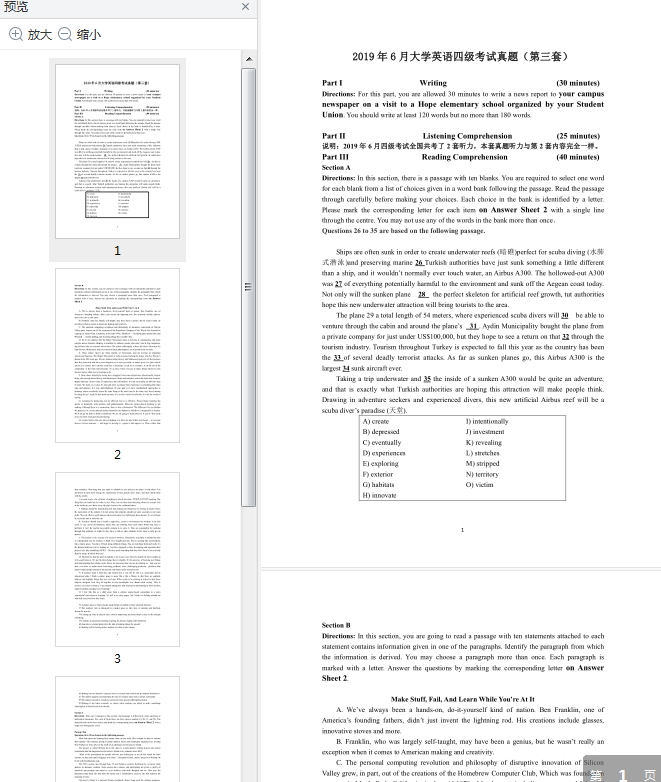
2019年6月四级真题第三套.docx
2019年6月份四级(第一套)试题.pdf
2019年6月份四级(第二套)试题.pdf
2019年6月份四级(第三套)试题.pdf
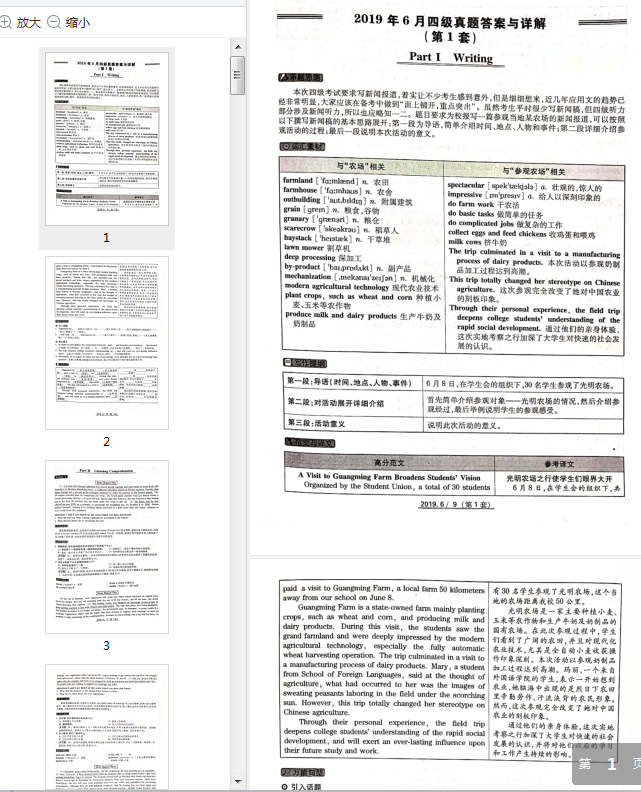
2019年6月份四级(第一套)答案解析.pdf
2019年6月份四级(第二套)答案解析.pdf
2019年6月份四级(第三套)答案解析.pdf
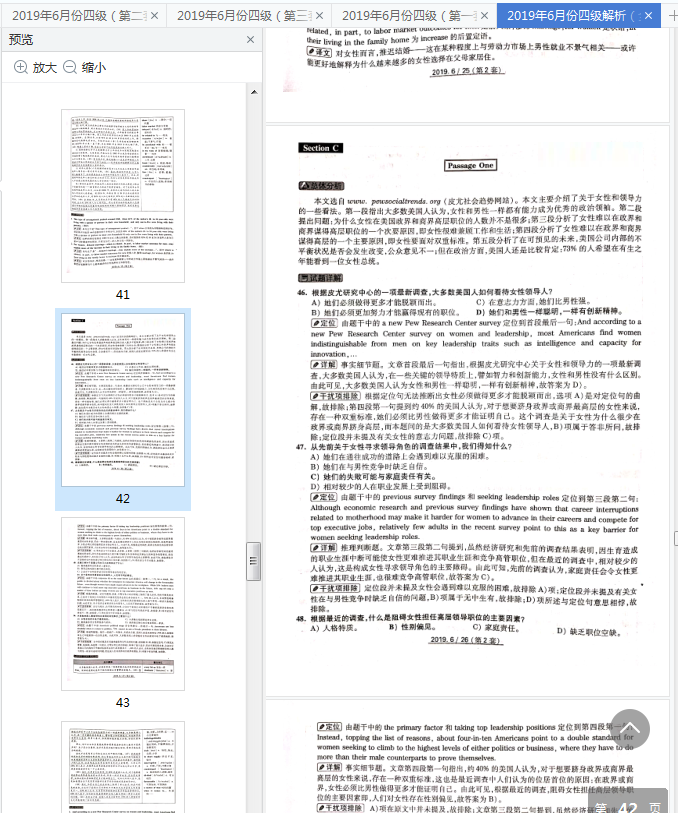
2019年6月份四级解析(全三套).pdf
2019.6四级第一套.m4a
2019.6四级第二套.m4a

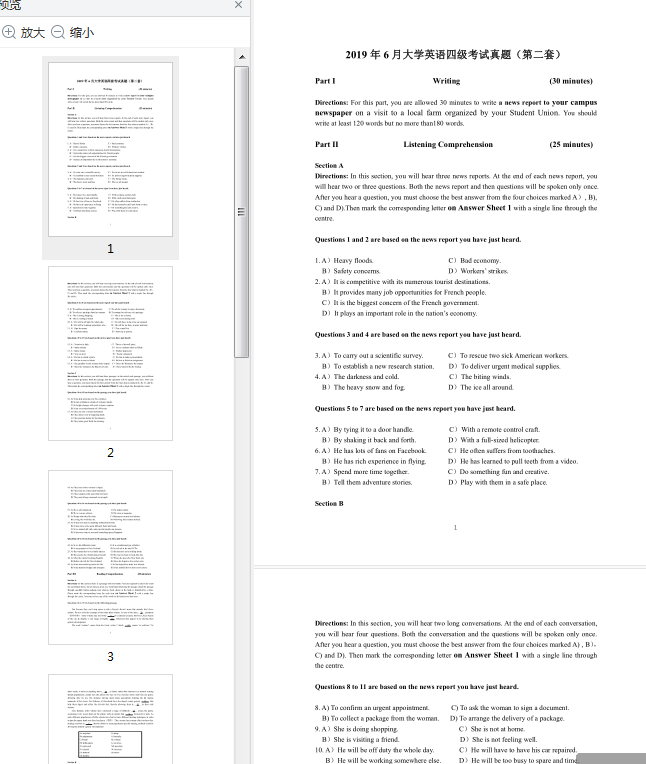
Section B
Directions:?In this section, you are going to read a passage with ten statements attached to it. Each statement contains information given in one of the paragraphs. Identify the paragraph from which the information is derived. You may choose a paragraph more than once. Each paragraph is marked with a letter. Answer the questions by marking the corresponding letter on?Answer Sheet 2.
How Work Will Change When Most of Us Live to 100
A) Today in the United States there are 72,000 centenarians(百岁老人).Worldwide, Probably 450,000. If current trends continue, then by 2050 there will be more than a million in the US alone. According to the work of Professor James Vaupel and his co-researchers, 50% of babies born in the US in 2007 have a life expectancy of 104 or more. Broadly the same holds for the UK, Germany, France, Italy and Canada, and for Japan 50% of 2007 babies can expect to live to 107.
B) Understandably, there are concerns about what this means for public finances given the associated health and pension challenges. These challenges are real, and society urgently needs to address them. But it is also important to look at the wider picture of what happens when so many people live for 100 years. It is a mistake to simply equate longevity (长寿) with issues of old age. Longer lives have implications for all of life, not just the end of it.
C) Our view is that if many people are living for longer, and are healthier for longer, then this will result in an inevitable redesign of work and life. When people live longer, they are not only older for longer, but also younger for longer. There is some truth in the saying that “70 is the new 60” or “40 the new 30.” If you age more slowly over a longer time period, then you are in some sense younger for longer.
D) But the changes go further than that. Take, for instance, the age at which people make commitments such as buying a house, getting married, having children, or starting a career. These are all fundamental commitments that are now occurring later in life. In 1962, 50% of Americans were married by age 21. By 2014, that milestone(里程碑)had shifted to age 29.
E) While there are numerous factors behind these shifts, one factor is surely a growing realization for the young that they are going to live longer. Options are more valuable the longer they can be held. So if you believe you will live longer, then options become more valuable, and early commitment becomes less attractive. The result is that the commitments that previously characterized the beginning of adulthood are now being delayed, and new patterns of behavior and a new stage of life are emerging for those in their twenties.
F) Longevity also pushes back the age of retirement, and not only for financial reasons. Yes, unless people are prepared to save a lot more, our calculations suggest that if you are now in your mid-40s, then you are likely to work until your early 70s; and if you are in your early 20s, there is a real chance you will need to work until your late 70s or possibly even into your 80s. But even if people are able to economically support a retirement at 65, over thirty years of potential inactivity is harmful to cognitive(认知的) and emotional vitality. Many people may simply not want to do it.
G) And yet that does not mean that simply extending our careers is appealing. Just lengthening that second stage of full-time work may secure the financial assets needed for a 100-year life, but such persistent work will inevitably exhaust precious intangible assets such as productive skills, vitality, happiness, and friendship.
H) The same is true for education. It is impossible that a single shot of education, administered in childhood and early adulthood, will be able to support a sustained, 60-year career. If you factor in the projected rates of technological change, either your skills will become unnecessary, or your industry outdated. That means that everyone will, at some point in their life, have to make a number of major reinvestments in their skills.
I) It seems likely, then, that the traditional three-stage life will evolve into multiple stages containing two, three, or oven more different careers. Each of these stages could potentially be different. In one the focus could be on building financial success and personal achievement, in another on creating a better work/life balance, still another on exploring and understanding options more fully, or becoming an independent producer, yet another on making a social contribution. These stages will span sectors, take people to different cities, and provide foundation for building a wide variety of skills.
J) Transitions between stages could be marked with sabbaticals (休假) as people find time to rest and recharge their health, re-invest in their relationships, or improve their skills. At times, these breaks and transitions will be self-determined, at others they will be forced as existing roles, firms, or industries cease to exist.
K)A multi-stage life will have profound changes not just in how you manage your career, but also in your approach to life. An increasingly important skill will be your ability to deal with change and even welcome it. A three-stage life has few transitions, while a multi-stage life has many. That is why being self-aware, investing in broader networks of friends, and being open to new ideas will become even more crucial skills.
L)These multi-stage lives will create extraordinary variety across groups of people simply because there are so many ways of sequencing the stages. More stages mean more possible sequences.
M)With this variety will come the end of the close association of age and stage. I n a three-stage life, people leave university at the same time and the same age, they tend to start their careers and family at the same age, they proceed through middle management all roughly the same time, and then move into retirement within a few years of each other. In a multi-stage life, you could be an undergraduate at 20, 40, or 60; a manager at 30, 50, or 70; and become an independent producer at any age.
N)Current life structures, career paths, educational choices, and social norms are out of tune with the emerging reality of longer lifespans. The three-stage life of full-time education, followed by continuous work, and then complete retirement may have worked for our parents or even grandparents, but it is not relevant today. We believe that to focus on longevity as primarily an issue of aging is to miss its full implications. Longevity is not necessarily about being older for longer. It is about living longer, being older later, and being younger longer.
36. An extended lifespan in the future will allow people to have more careers than now.
37. Just extending one’s career may have both positive and negative effects.
38. Nowadays, many Americans have on average delayed their marriage by some eight years.
39. Because of their longer lifespan, young people today no longer follow the pattern of life of their parents or grandparents.
40. Many more people will be expected to live over 100 by the mid-21st century.
41. A longer life will cause radical changes in people’s approach to life.
42. Fast technological change makes it necessary for one to constantly upgrade their skills.
43. Many people may not want to retire early because it would do harm to their mental and emotional well-being.
44. The close link between age and stage may cease to exist in a multi-stage life.
45. People living a longer and healthier life will have to rearrange their work and life.
2019年6月英语四级真题作文参考范文:参观养老院
【四级真题作文题目】:
“For this part, you are allowed 30 minutes to write a news report to your school newspaper on a volunteer activity organized by yous Student Union to help elderly people in the neighborhood. You should write at least 120 words but no more than 180 words.”
【四级真题作文参考范文】
On June 14, Friday, a volunteer activity where many students took an active part in visiting the local Nursing House was organized by the Student Union and it turns out to be a big success.
The activity was aimed at encouraging students to visit the elderly at the Nursing House and help elderly people deal with their troubles both physical and psychological. Many students volunteered to participate in this good deed and were engaged in helping the elderly here out by making their meals, washing their clothes and chatting with them. When asked about those volunteers’ feelings about such an experience, all of them responded with a smile, saying “what a wonderful practice and I really appreciate this experience, for it makes me learn to care more for others in need.”
All in all, the activity turns out to be a success not only for the visited elderly but for those students involved.
【四级真题作文参考范文译文】
6月14日,星期五,学生会组织了一个参观当地敬老院的志愿活动,许多学生都积极参与其中,该活动取得了巨大的成功。
此次志愿活动旨在拜访当地敬老院的老人们并对他们各个方面的困难提供帮助。许多学生主动加入到此次善举当中,帮老人们洗衣做饭、谈心解闷,竭尽所能提供帮助。问及参与此次活动的感想时,他们毫无例外地回道“真是太有意义了,很感谢这次经历,它让我懂得要去更加关爱那些有困难的人”
总而言之,此次活动取得了巨大成功,不仅仅对那些老人来说受益多多,对于参与的学生来说也是意义良多。




 2020全国中考英语真题试卷及答案解析整合版
 教程资料 / 10.7M / 26-07-24下载
  2020年二级建造师《建筑工程管理与实务》PDF版资料2020最新版教程资料 / 6.2M / 20-10-26下载
  Conefor Sensinode 2.6用户手册(中文版)docx免费版教程资料 / 126KB / 26-07-23下载
  2020年《金融市场基础知识》模拟试卷汇总(三套)PDF版完整版教程资料 / 3.1M / 26-07-23下载
  2021高考英语一轮复习真题和模拟题汇编pdf免费下载高清版教程资料 / 4.8M / 26-07-22下载
  2021高考生物组成细胞的分子和细胞的基本结构第一讲world版dox免费完整版教程资料 / 860KB / 26-07-23下载
  2020考研英语一真题及答案解析完整版pdf免费版高清无水印版教程资料 / 303KB / 26-07-24下载
  2021高考生物细胞的物质输入和输出酶和ATP电子版docx免费版教程资料 / 2.3M / 26-07-24下载
  《证券市场基本法律法规》模拟试卷汇总world免费版docx完整版(附答案)教程资料 / 4.5M / 26-07-24下载
  2021考研政治强化阶段测试及答案pdf免费下载高清完整版(两套)教程资料 / 688KB / 26-07-24下载
  2021新高考生物课后限时集训1~42整合版免费版
 amesim液压元件设计库教程电子版






 2020全国中考数学真题试卷及答案解析汇总大全
 黄冈历年中考物理试卷及答案解析2007-2020年整合版
 2021各科中考总复习专题知识要点pdf整合版
 黄冈中考英语试卷及答案2007-2020整合word版